


I haven’t found an engineer I respect who advocates for complex solutions (and I’ve been looking hard). The GOATs love complex problems - the type worthy of capturing their thinking for years. They’re also the type who morally reject complex solutions to those complex problems.
While their peers tolerate clumsiness under the guise of pragmatism, they’re prepared to jeopardize their whole careers to prove that it doesn’t have to be so complicated. They’ll bushwhack their way into the jungle of complexity so that they can prove to themselves that nature always provided a simple path through it.
DIRAC’S EXAMPLE
Let’s take Paul Dirac, the electrical engineer turned theoretical physicist who helped found quantum mechanics.
In 1926, Schrödinger pulled up with a quantum mechanics equation that explained the hydrogen atom and made chemistry computable. But it broke down for particles moving at the speed of light.
The obvious fix was to build relativity in, which the Klein-Gordon equation did. It was relativistic, but clumsy for electrons because it was second-order in time. Most physicists were willing to move on. Not Dirac.
“Most physicists were quite happy... but I was very unhappy about it.”
— Dirac, Basic Beliefs and Prejudices in Physics, 1976
Relativity put space and time on similar footing; why shouldn’t the relativistic quantum equation also be first-order in both?
So he spent two years figuring it out.
The breakthrough was to factor Einstein’s energy equation using matrices instead of ordinary numbers. The result was the Dirac equation:
Relativity was built in. The electron’s spin and antimatter emerged naturally. Dirac’s equation described the world more accurately with fewer assumptions. It wasn’t simpler in the naive sense, however. It introduced four-component wave functions and matrices instead of ordinary numbers, after all. But it was more beautiful.
THE TENSION OF SIMPLICITY
I love Dirac’s example because it resolves an inherent tension in my emerging religion of simplicity: In the pursuit of first-order simplicity, one has to accept second-order complexity.
For example, say you’re building an API. You make it simple; it covers 95% of use cases effortlessly. If your customers have a 5% use case, however, using your simple API will be painfully complex. (See my Google Calendar case study). Simplicity for one party often means complexity for another.
Dirac found a way out of this bind through addition, not subtraction. He added the requirement of mathematical beauty to the solution. The pursuit of beauty led him down a path that no one else was willing to take, one where the math was deeper, but the application wider.
We now see that we have to change the principle of simplicity into a principle of mathematical beauty. The research worker, in his efforts to express the fundamental laws of Nature in mathematical form, should strive mainly for mathematical beauty. He should still take simplicity into consideration in a subordinate way to beauty. (For example Einstein, in choosing a law of gravitation, took the simplest one compatible with his space-time continuum, and was successful.). It often happens that the requirements of simplicity and of beauty are the same, but where they clash the latter must take precedence.
— Dirac, The Relation between Mathematics and Physics, 1939
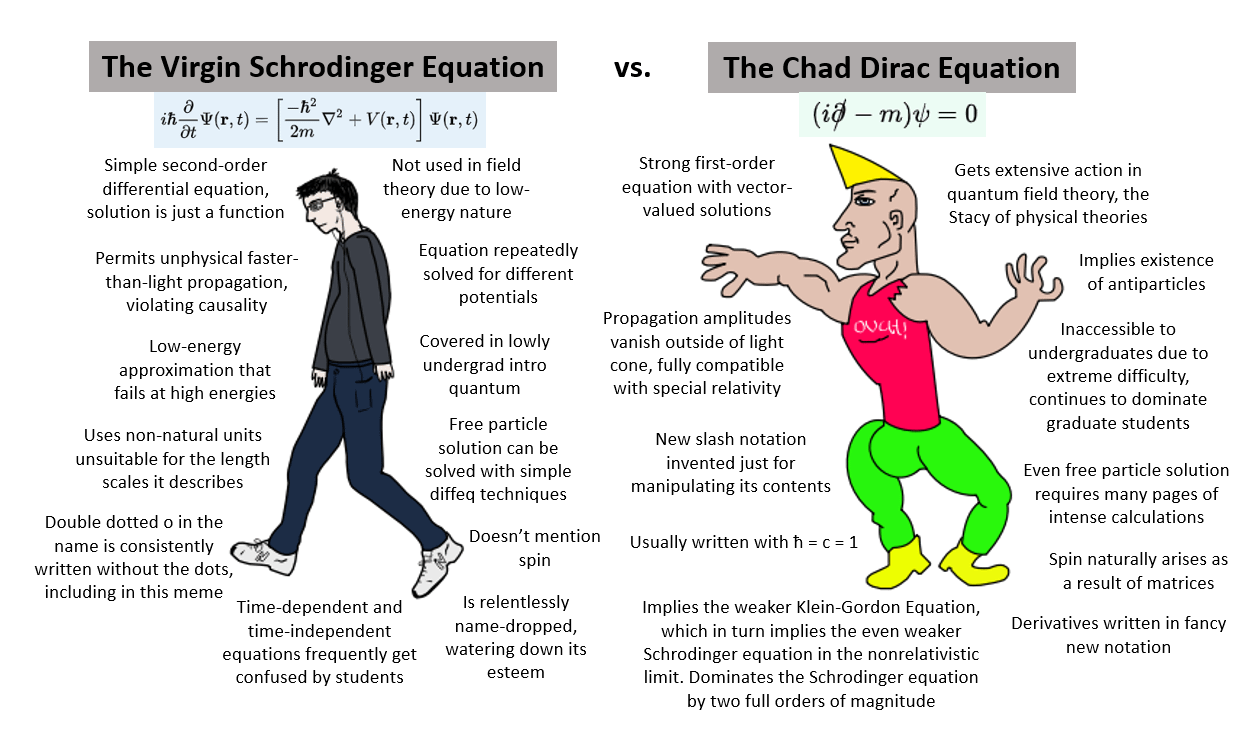
That commitment to beauty is why Dirac’s equation became a foundation of quantum field theory, earned him the Nobel Prize, and still has physicists making memes about it today.
WHAT’S THE POINT?
Whether you’re architecting your morning routine, a fleet of AI agents, or the new primitives of quantum mechanics, I think Dirac’s playbook applies:
You don’t have to tolerate complexity
Finding a simple yet acceptable alternative is hard
When stuck, add a requirement (e.g., beauty)
MORE
The Relation between Mathematics and Physics (Dirac’s transcript)
