
The first lecture of my college English class taught me to survive as a software engineer.
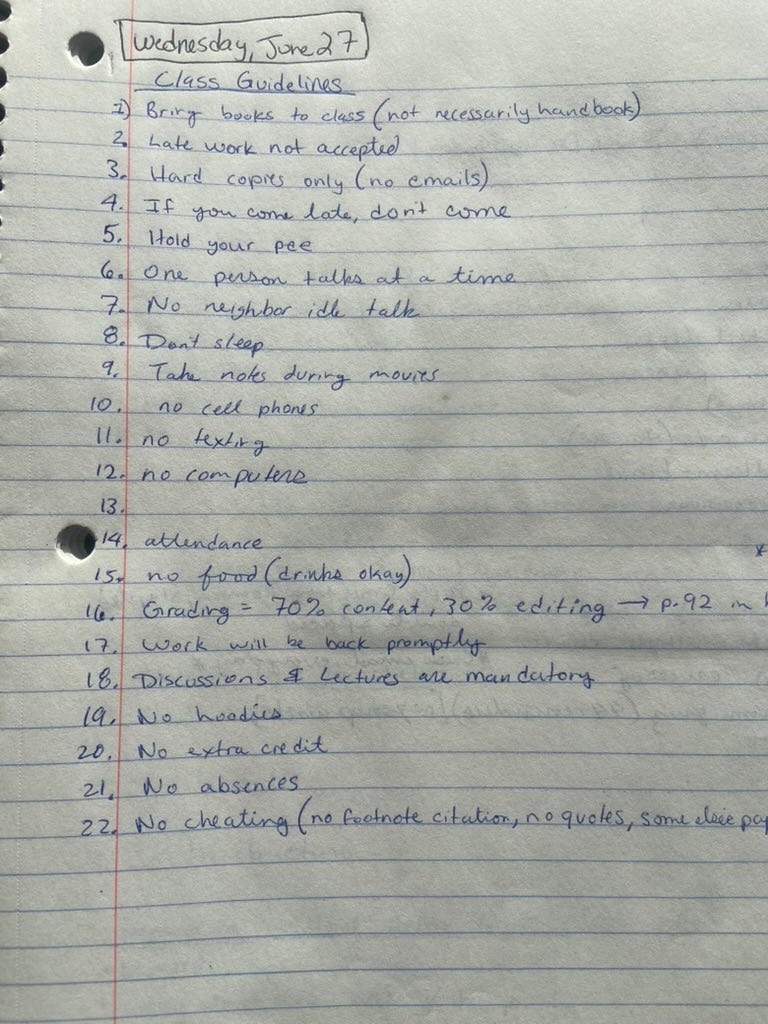
The professor asked everyone to open their notebook and write down the following class guidelines:
Bring books to class
Late work is not accepted
Submit hard copies only (no emails)
If you come late, don’t come
Hold your pee
One person talks at a time
No neighbor idle talk
Don’t sleep
Take notes during movies
No cell phones
No texting
No computers
Sign in
No food (drinks OK)
Paper grades are based on 70% content, 30% editing
Grades will be returned promptly
Discussions & lectures are mandatory
No hoodies (see #8)
No extra credit
No absences
No cheating
My high school teachers warned us that college would be different. I assumed they were exaggerating to scare us into being quiet. I quickly realized they were just telling the truth. I glanced across the room and saw dozens of other wet-behind-the-ear students having the same realization.
Some scoffed indignantly, as if the professor’s standard was unreasonable.
Some looked defeated, as if they had already received a C-.
But a few lit up.
These were the future A-students. They came to college hungry for knowledge. They were excited that an authority figure challenged them, rather than admired their intelligence. They appreciated that he was also holding himself to a high standard (#15, #16).
The high standard offended the C students and inspired the A students.
You probably know where I’m going with this:
This phenomenon doesn’t stop after college.
Show me an engineer who reads a job description and complains, and I’ll show you a C-player.
High expectations threaten these people because they expect to coast without consequence.
The same expectations excite the A-players because they recognize that they need to get to improve.
What to do with this info day-to-day?
Depends what kind of student you want to be.
Are you good with modest improvements in skill, income, and influence? Do competition, candor, and performance metrics drain you? Do you need work-life balance? Then you can expect to get a C or B.
All good, I won’t shame you or try to convince you to go for an A. Just don’t fool yourself.
If you aspire for As, on the other hand, don’t let the C players bring you down. You might be in the same company as them, but the rules are different. They just need to show up and do the minimum. You need to do the most.
Practically, this means doing the functions listed on your job description and then doing part of another person’s job.
^ That seems crazy, but it works. Instead of trying to explain it here, I’ll just point you to my deep dive on YouTube.
I was hesitant to share this harsh message until I realized that silence comes at the expense of the aspiring A-Players. Every scoff from someone who doesn’t aspire towards greatness has the potential to discourage someone who does.
We need more A-Players in this field, especially now.
If you’re on the fence, it might help to know this last detail:
Although I was initially terrified by my English professor’s expectations, I decided to give it my all anyway. It was hard work, but I got an A. But this is the best part: We stayed in touch after the class ended. We initially chatted about books, then music, then life. It’s been fourteen years since that first lecture, and I’m so proud to say that my professor is now my best friend.
Takeaway:
A-Players attract one another.
If you want to surround yourself with exceptional people, you need to become one yourself.