

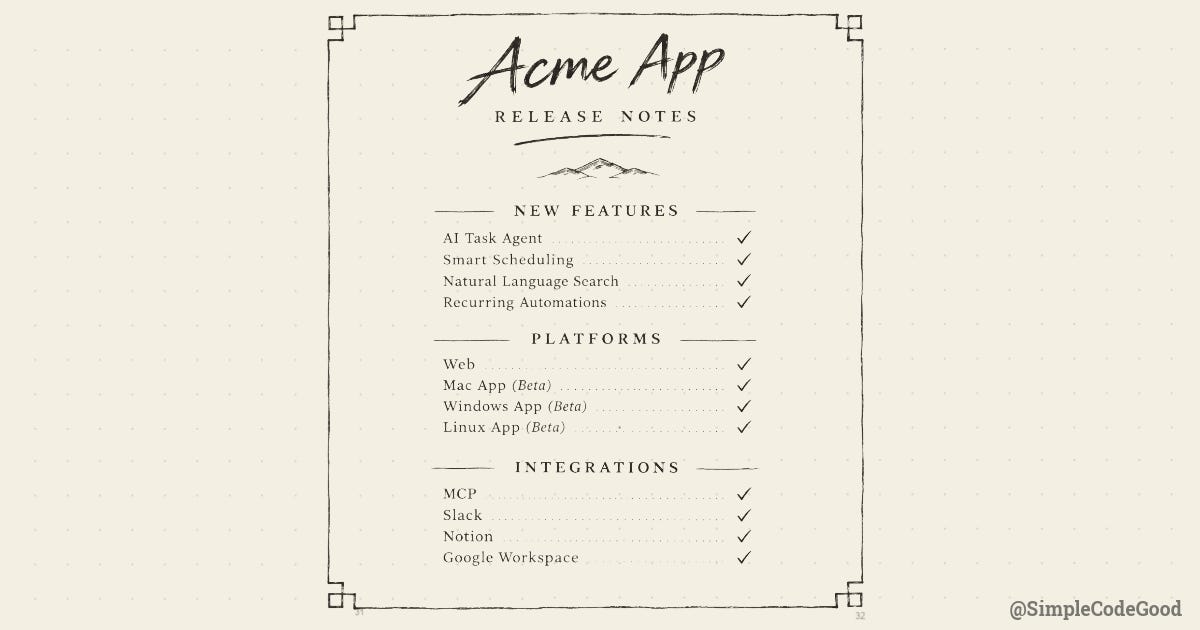
Have you seen a release note recently? They look more like a Chinese restaurant menu than something a human would actually type, let alone read.
20 new features!
3 more platforms!
MCP!
As a user, I’m fed up. Everyone is building everything all at once, and I’m struggling to stay aware of all the new capabilities, let alone use them.
As a builder, I’m fired up. I can build everything all at once for $20/month, and I’m struggling to hold my agents back, let alone test their work.
Until this week.
For the last six years, I’ve been building a calendar app. I initially built it in Electron so that I could ship a desktop app on Windows, Mac, and Linux. That was a nightmare, so I sunset those platforms and focused on the web. The web is where I stayed for years, honing the design and stabilizing the API. The web app’s stability, agents’ increasing capacity, and my lingering FOMO recently got me thinking: What if I built a native Mac app? AI knows Swift code well, I use a Mac, and the infra plumbing is already there. How hard could it be?
Turns out, it’s not hard. It’s just complex.
You need to enroll in the Apple Developer Program, which requires a DUNS number, which requires a form and a bank transfer to a business checking account. You need to decide whether to go on the App Store and tolerate their 30% surcharge or go direct and worry about code-signing. You need to figure out how to distribute updates without locking the UI. The product needs to be tweaked for universal shortcuts and menu items that the web doesn’t afford. Automations need to be written to maintain parity across the web and native apps. The favicon needs to be converted to an app icon. CI flows need conditionals to prevent running the entire web suite after a one-line Swift change. Onboarding, observability, logging, and automatic bug-fixing flows need to be tweaked. Oh, and you need a new Mac, because agent sandboxes run Linux and the native tests commandeer your screen.
Through a combination of stubbornness, tokens, and naiveté, I got past all those hurdles. I finally got a calendar for the web and native Mac. I started fantasizing about how impressive my next release notes would look. There were just two problems:
The Mac app sucked
I was exhausted
While none of the individual responsibilities that the new platform required were overwhelming, the sum was. Just getting the product to baseline without breaking the web or slowing cycles down was tiring (My CI time shot up from a few minutes to over 60, causing lots of strife between me and my agents). And for what? So I could brag about being multi-platform, only to disappoint the users who took the extra time to install the binary?
Sober from my token debauchery, I finally resolved to do the thing I harp on every week here: Keep it simple.
I deleted the Swift code and focused back on the web.
The release notes won’t be as impressive this month, but the users won’t waste their time on a subpar product, and I won’t waste mine maintaining a platform for the sake of my ego.
Every team has a limit — a moment when their legs start to buckle under the mass of code they’ve accumulated. I found mine; As a solo, bootstrapped dev in Nov 2026, I can’t ship a premium web calendar app and a premium Mac app. And that’s OK.
What about you? Are you getting exhausted from all the weight you added recently? Are you carrying around more than you have stamina for? Have you confused quantity of features with quality of features?
If so, here’s your reminder:
It’s OK to keep things simple.
More
Compass Calendar (web app)
Carry-on codebases (article)
